Advanced Training Course on New Power System Relay Protection: Standard Implementation, Setting Calculations, Intelligent O&M, and Analysis of Typical Accident Cases
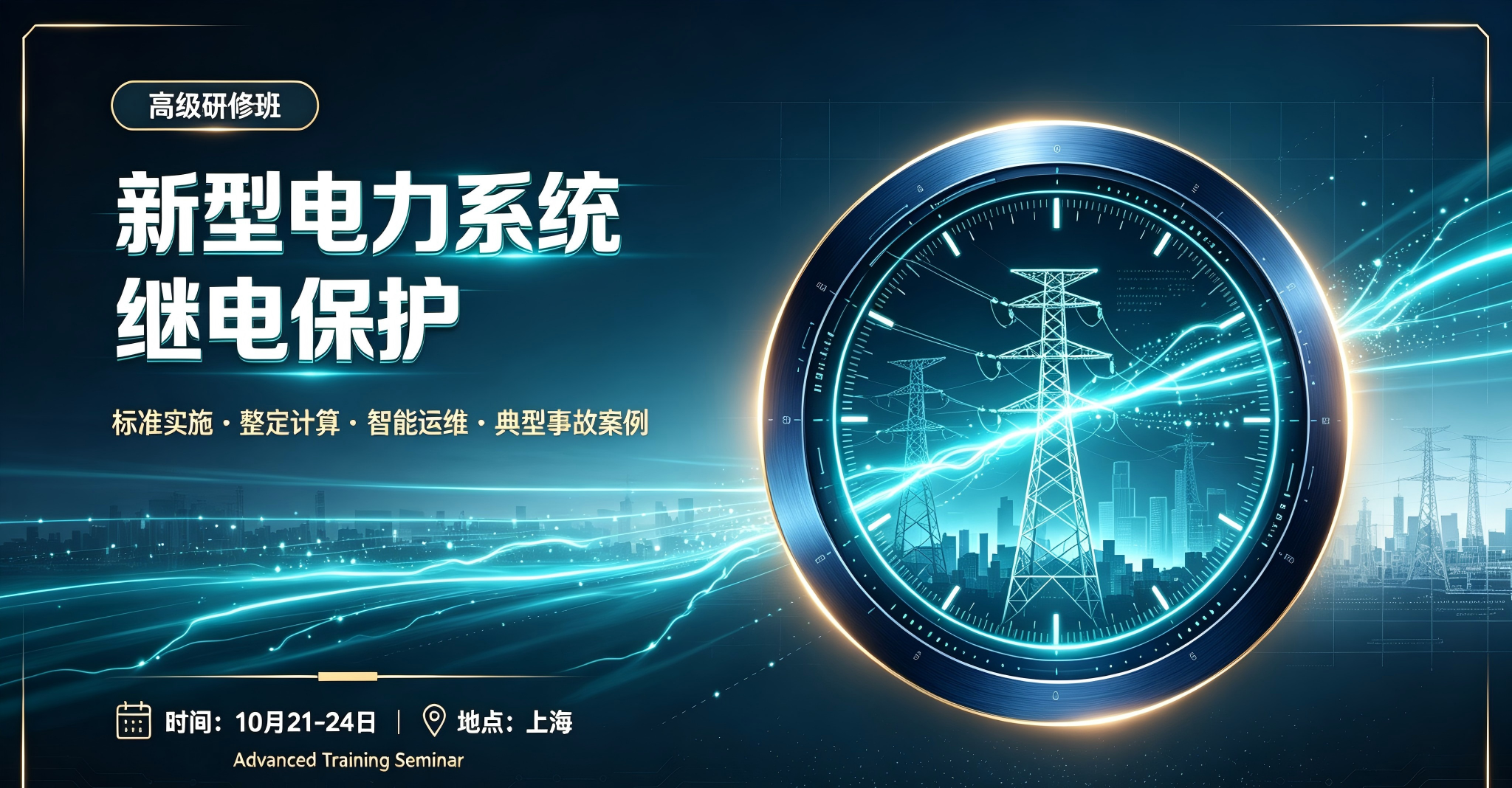
Advanced Training on Implementation, Setting Calculation, Intelligent O&M, and Analysis of Typical Accident Cases for Relay Protection Standards in New Power Systems – Shanghai, 10/21–24
Notice on the Advanced Training Program for Implementation of Relay Protection Standards, Setting Calculations, Intelligent Operation and Maintenance, and Analysis of Typical Accident Cases in New Power Systems
To all relevant enterprises:
In China, new energy installed capacity now exceeds that of traditional power sources, altering fault patterns in the power system. Inverter-based generation, bidirectional power flow, and weak-grid conditions pose adaptation challenges for conventional protection systems. Meanwhile, a wave of new national and industry standards for relay protection, alongside updated cybersecurity regulations for power monitoring systems, are being rapidly implemented. Technologies such as intelligent operations and maintenance (O&M), SCD virtual circuit management, AI-driven fault identification, and digital twins are accelerating adoption.
The field faces significant engineering challenges, including difficulties in coordination settings for new energy stations, detecting hidden defects in virtual circuits, downstream fault escalation on the user side, protection anomalies triggered by peak-shaving or operational mode switching, and cybersecurity compliance risks. To help professionals master new standards, solve complex setting calculation problems, and enhance intelligent O&M capabilities and accident analysis skills, we are launching this advanced executive training program. The program focuses on practical engineering applications, in-depth analysis of key challenges, and case study discussions.
1. Time and Location
Time: 10/21–24 (Check-in on the full day of 10/21)
Location: Shanghai Shuguang Wei Hotel (No. 11, Lane 199, Jinyun Road, Jiading District, Shanghai)
II. Target Audience
Power grid dispatching, operation and maintenance, and electric power research institute relay protection technical and management personnel
Thermal, hydro, wind, and solar power plants; energy storage facilities. Professionals in electrical systems, relay protection, setting values, and operations & maintenance.
Total Substation for Large-Scale Industrial and Mining Enterprises | Technical Supervisor in Power Supply & Distribution O&M and Grid Protection Management
Secondary design personnel at power design institutes, R&D and on-site technical support specialists at relay protection equipment manufacturing companies, and researchers at universities and research institutions.
Training Content
Practical Guide to Fault Characteristic Changes and Setting Calculations for New Power Systems
1. Real-world challenges posed to traditional relay protection by high penetration of renewable energy
Inverter-type power supply fault current limitation causes insufficient overcurrent protection sensitivity.
Impact of missing negative-sequence and zero-sequence fault currents under weak-feed conditions on directional and distance elements.
Impact of System Bidirectional Power Flow on Distribution Network and Station Protection Selectivity, and On-Site Mitigation Strategies
2. Challenges and Engineering Solutions for Setting Calculations in Multi-Source Coexistence Scenarios
Key Points for Short-Circuit Current Calculation in Distributed Power Systems and Common Pitfalls in Setting Verification
Practical Methods for Directional Discrimination and Setting Coordination of Overcurrent Protection under Bidirectional Power Flow
Adaptive Protection and Online Setting Application: Engineering Boundaries and Scenarios to Avoid
3. Interpretation of the New National Standard GB/T 32900‑2025: "Technical Requirements for Relay Protection of Photovoltaic Power Stations"
Scope of Application: Photovoltaic power stations (including supporting electrochemical energy storage) at 10kV and above
Add mandatory protection clauses for weak grid adaptation.
Key Requirements and Implementation for New Regulations on Full-Process Management of Protection Configuration, Setting Calculation, and Value Settings in PV Power Stations
4.DL/T 2645-2023 Analysis of "Technical Specification for Distributed Protection in Distribution Networks"
Scope of Applicability and General Technical Requirements
Distributed Protection Functions and Setting Principles
Distributed vs. Centralized Protection: Selection, Coordination, and Case Studies
(II) Intelligent Substation O&M Risks, New Cybersecurity Regulations, and Multi-Type Power Source Protection
1. Practical Guide to Identifying Hidden Defects and Verifying Configurations of Virtual Circuits in Intelligent Substation SCD Files
Real-world challenges in daily verification of SCD virtual terminals and analysis of high-risk points for human configuration errors
NB/T 11783-2025 "Technical Specification for Automatic Verification of Virtual Terminal Circuits in Intelligent Substation Configuration Files"
In-depth Analysis of Real Accidents Caused by SCD Configuration Errors Leading to False Tripping or Failure to Trip
Engineering implementation of automatic verification and visual warning technologies for virtual loops
2. Interpretation of the Special Topic on Relay Protection in the New Regulations for Safety Protection of Electric Power Monitoring Systems (Order No. 27)
Implementation of Core Clauses of Order 27 in Year 2025: Compliance Risks for Relay Protection Professionals
Special security requirements for power monitoring systems in new energy, energy storage, and virtual power plant scenarios
Key Points and Construction Considerations for Cybersecurity-Related Group Standards of Intelligent Operation and Maintenance Platform for Relay Protection
3. Prevention of grid-related protection hazards and cascading trips on the user side
Common weaknesses in protection systems for industrial and mining users
Mechanisms of cascading failures and selective tripping caused by user-side faults
Post-mortem of a Typical Case: Cascading Ground Fault Due to Mismatched Zero-Sequence Settings
Energy Administration User-Side Grid-Connected Safety Management Documents: Key Points for Protection Configuration and Setting of 10 (20) kV Users
4. Protection Risks and Setting Guidelines for Deep Peak Shaving in Thermal Power Plants and Frequent Operating Mode Switching in Hydroelectric Plants
Risks to Generator-Transformer and Auxiliary Power Protection Coordination Settings Under Deep Peak-Shaving Conditions
Risks and Preventive Measures for Hydro-Electrical Interlock Protection Settings During Flood Season and Frequent Start-Stop Switching
(III) Typical Misoperation and Failure-to-Operate Cases; AI and Cutting-Edge Digital Technologies
1. In-depth analysis of typical misoperation and failure-to-operate accidents in relay protection for multi-power source scenarios
Real-World Case Studies on Grid-Connected Tripping, Generator-Transformer, and Main Transformer Anomalies in New Energy Systems
Identify hidden secondary defects using fault recording data
2. Deployment and application of digital new technologies such as AI and digital twins in relay protection.
Current State and Limitations of Intelligent Fault Identification and Classification Applications
Digital Twin Applications in Condition Assessment and Online Monitoring Engineering Practice
Protection Device Configuration Optimization Technology Based on IEC61850+ Big Data
Data-driven dynamic optimization of setpoints
3. Joint Seminar on Common Challenges in Relay Protection for Power Generation, Grid, and User-Side Systems
Exchange on field issues including setting calculations, full-process setpoint management, intelligent operations and maintenance, and standard compliance.
IV. Featured Expert
The instructor team is comprised of senior power grid relay protection experts, non-stop accident analysis specialists for power generation, security experts for electric power monitoring systems, primary drafters of national and industry standards, and professors from leading power engineering universities.
Senior Grid Expert: Responsible for new energy protection configuration, setting calculations, intelligent operations & maintenance, and accident case studies.
Generation-side Expert: Focused on thermal and hydro unit protection, plus analysis of unplanned outages.
Standard/Security Expert: Interpretation of the New Regulations and Special Training on Cybersecurity Compliance for Power Monitoring Systems
University Expert: Keynote on Cutting-Edge AI Digitalization and Digital Twin Technologies
5. Fee Structure and Payment Terms
Please remit payment by 9/30. Fee: 3600 per person. Accommodation, meals, and transportation are not included.
Remittance Account: Beijing Guopei Dianyan Consulting Co., Ltd.
Bank: Industrial and Commercial Bank of China, Beijing Taipingqiao Branch
Account: 0200020309020804917
VI. Registration
Please send the registration confirmation and remittance receipt to the conference secretariat via email or WeChat by 9/30.
Registration email: ceptc@vip.163.com
Contact: Teacher Zhao 18501038505 (WeChat same)